Two weeks ago it was the clearest lesson of the AI year: Anthropic's Fable 5 — the most powerful publicly available model — was there on Monday and gone by Thursday, switched off worldwide by order of a US authority. Today, on 1 July 2026, it is back. And that is exactly what makes the story truly instructive for data-sensitive companies.
Because the return does not refute the lesson — it sharpens it. A frontier model that a foreign government can switch off within 72 hours by a letter the public is not even allowed to read, whose return requires a lawsuit and a two-week review, and which even after the return offers no zero-data-retention, is a rented tool — not a foundation. Let's look closely. (We described the backstory in Fable 5 is here — and why the strongest AI model alone isn't enough.)
What happened? The chronicle in just over three weeks
Between 9 June and 1 July 2026, Fable 5 ran through a complete cycle of launch, worldwide suspension and return. The documented sequence shows how quickly the availability of a frontier model can flip — and how little a customer can do about it.
- 9 June: Anthropic releases Fable 5, its most powerful public model per the vendor (details in the original Anthropic announcement).
- 12 June, 5:21pm ET: The US Department of Commerce issues an export-control directive to "suspend all access to Fable 5 and Mythos 5 by any foreign national, whether inside or outside the United States". Because Anthropic cannot distinguish foreign nationals from US persons in real time, it disables both models worldwide for everyone.
- 16 June: Bloomberg publishes the text of the otherwise non-public government letter (a press leak, not an official release).
- 23 June: Anthropic customer Legion LegalTech sues the government in the US District Court for the District of Columbia to vacate the directive.
- 26–27 June: Commerce Secretary Howard Lutnick first clears Mythos 5 only for around 100 approved US organizations and agencies.
- 30 June: The Department of Commerce lifts the export controls on Fable 5 and Mythos 5.
- 1 July: Fable 5 is back, available "to users globally".
Why was Fable 5 suspended — and how did it come back?
The trigger was a jailbreak report from Amazon researchers who bypassed Fable 5's safeguards to identify software vulnerabilities — in one case the model produced code showing how a flaw could be exploited. The US government treated this as a national-security risk and issued the export-control directive. Anthropic pushed back: the same tasks were solved, per the vendor, by weaker, publicly available models (it names Claude Opus 4.8, GPT-5.5 and Kimi K2.7) — this was "routine defensive security work", not a hidden super-capability.
Legally, the order was not a published entry on the Commerce Control List but a non-public "is informed" letter under BIS's export-control authority, signed by Commerce Secretary Lutnick. Constitutional lawyer Brian Egan (formerly of the US State Department) called the breadth of the order —while noting the mechanism itself is established— "unprecedented". A frequently cited detail — that the government gave only around 90 minutes to comply — comes from the Legion LegalTech complaint and is therefore a plaintiff's characterization, not officially confirmed.
For the return, Anthropic says it trained an improved safety classifier such that "the specific technique described in the Amazon report is blocked in over 99% of cases". After a roughly two-week review, the Department of Commerce lifted the controls on 30 June. An important caveat: the 99% figure is Anthropic's own statement and not independently verified; Anthropic itself calls it a mitigation, not a hundred-percent fix — making a model fully robust to jailbreaks is "probably impossible".
The return is good — but it does not refute the lesson
That Fable 5 is back is good news. But it changes nothing about the three structural facts that made the incident explosive in the first place — on the contrary, the return makes them more tangible.
First: availability is externally controlled. A tool that a foreign government can switch off by a letter the public may not even read is no foundation for production operations. Foreign nationals — i.e. EU and German companies — were not collateral damage here but explicitly the target of the block.
Second: data control did not improve. Mythos-class models are, per Anthropic, "retained for 30 days … on every platform where these models are offered" — with no zero-data-retention. Anyone who otherwise has a ZDR agreement must first enable retention to be allowed to use these models; this holds across the direct API, AWS Bedrock, Google Cloud and Azure. This rule is from the original release and did not change on the return. So the strongest model still offers less data control, not more.
Third: access remains asymmetric. Fable 5 returns globally — but the more powerful Mythos 5 only for around 100 approved US organizations and agencies. For an EU company that means: even after the "happy ending", the top tier is tied to a US approval list you are not on.
Availability vs. control — the comparison that matters
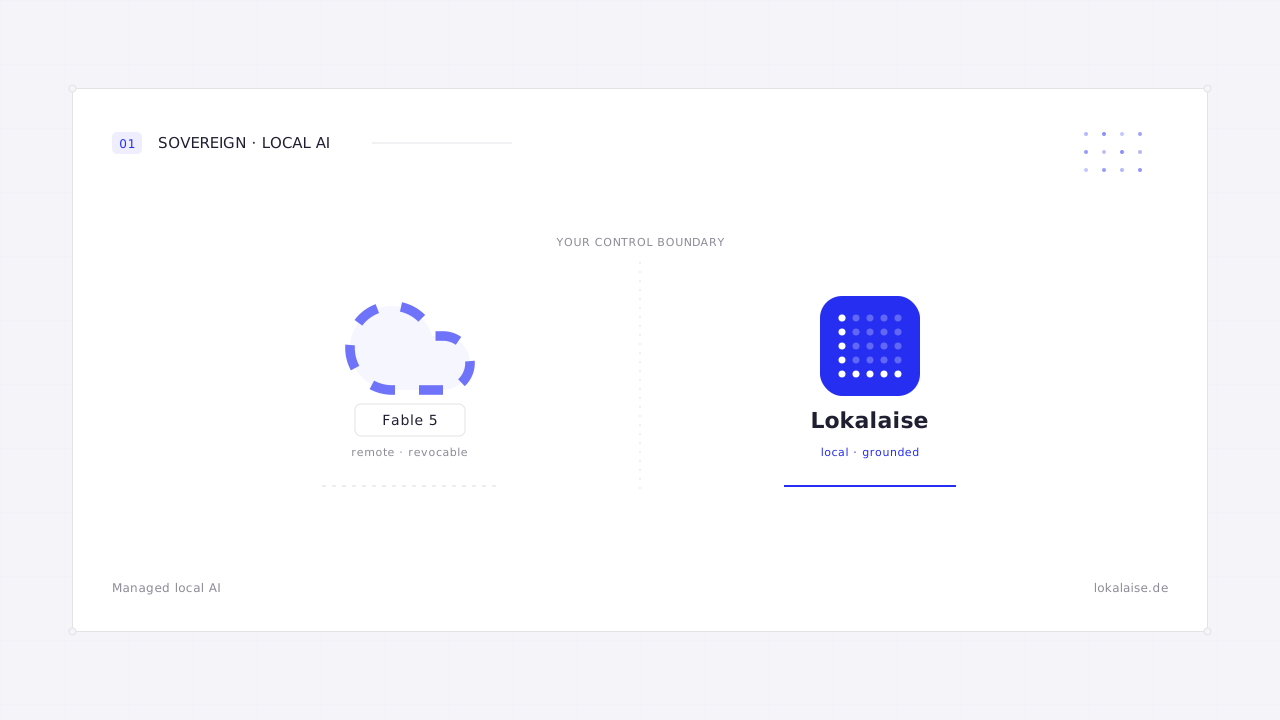
The Fable 5 cycle is not an argument against powerful models but against dependency. It cleanly separates two things that marketing likes to blur: rented model capability and your own control over data, operations and access.
| Dimension | Cloud frontier model (e.g. Fable 5 via API) | Local, grounded AI stack |
|---|---|---|
| Availability | externally controlled — switched off worldwide within 72h by a government letter | in your hands — keeps running on your own hardware |
| Jurisdiction | US law (export controls, CLOUD Act) | your own jurisdiction, no US addressee |
| Data residence | provider servers | in-house, your own hardware |
| Zero-data-retention | none — 30 days mandatory, even after the return | by design: data does not leave the building |
| Access to the strongest model | Mythos 5 only for ~100 US organizations (Annex A) | independent of foreign approval lists |
| Knowledge grounding | generic — does not know your documents | grounded in your documents (RAG), sourced answers |
This is the same logic we described for the BSI C3A criteria catalog: an EU data center alone is not sovereignty as long as the provider is subject to foreign law. And in law-firm practice the US CLOUD Act shows the same asymmetry — just with client confidentiality instead of model access.
The bigger context: sovereignty is becoming law
Fable 5 is not an isolated case but a visible spike in a trend that legislators on both sides of the Atlantic have long been addressing. Two documented developments from the first half of 2026 frame the incident.
On the EU side, the European Commission presented the Cloud and AI Development Act (CADA) on 3 June 2026 as the centrepiece of its "Tech Sovereignty Package" — explicitly to reduce dependence on non-EU cloud providers, which it classifies as a strategic risk. CADA introduces an EU-wide sovereignty framework with four assurance levels (covering, among others, data location, independence from third countries, EU ownership and supply-chain control). Important: CADA is so far a proposal, not applicable law — final adoption is targeted for around the end of 2027.
On the US side, the "AI Diffusion Rule" (published on 15 January 2025) illustrates the mindset of geographic access tiering: a draft divided the world into tiers — around 18 named allies (including Germany) with streamlined access, other countries with capped quotas or a presumption of denial. For context: this rule was withdrawn by BIS on 13 May 2025, two days before it was to take effect, and never gained legal force. So it shows the intent of geographic AI gating, not the current legal position — and the Fable 5 order moved in exactly this logic.
In honest counter-balance: what speaks for the cloud
Credibility requires naming the other side fairly. Four objections are valid:
- The incident was exceptional. Lawyers called the breadth of the order "unprecedented"; it was lifted again in around 18 days. Such a worldwide ban is not an everyday event.
- Anthropic fought back. The provider publicly disputed the classification and a customer sued — the interests of a managed-cloud provider and its customers largely coincide here: both want to keep operations running.
- The frontier remains impressive. Fable 5's showcase feats — a reported one-day migration of a roughly 50-million-line Ruby codebase at Stripe, a one-million-token context — mark a gap that locally runnable models have not yet fully closed.
- On-premise has costs. Your own GPUs, operation and maintenance are not free; a managed cloud service is convenient and often highly available.
These objections do not refute the sovereignty thesis, they refine it. The right question is not "cloud or local?" but "which work may depend on a foreign letter — and which may not?". For general, non-critical tasks a frontier model can be the right choice. For sensitive, regulated, business-critical processes, a local stack anchored in your own knowledge is the more robust foundation.
What this means for you
The effective lever is not giving up capability, but separating capability from dependency. A grounded AI platform on your own hardware connects your documents permission-aware, without them leaving the building. This requires no outbound connection, there is no foreign addressee for an export control or the CLOUD Act, and the question "zero-data-retention, yes or no?" no longer arises — the data stays structurally in-house (see Security & data sovereignty).
That is exactly what makes Lokalaise an enabler: powerful, locally runnable models, grounded in your own knowledge, under your control — a stack that survives the next suspension, price change or policy reversal, because it does not hang on a foreign approval list. Fable 5 was allowed to work on Monday, not on Thursday, and again three weeks later. Your business should not have to ride that rollercoaster.
Your next steps
Three questions show how large your dependency risk is:
- Shutdown risk: Which of your production processes would grind to a halt if a single externally controlled model were no longer reachable tomorrow?
- Data control: Does sensitive data leave your premises for AI use — and is mandatory retention with no zero-data-retention compatible with your compliance duties?
- Anchoring: Does your actual AI value sit in the rented model or in your own, grounded knowledge?
Where you hesitate, a closer look pays off. In a short demo we show you how a local, permission-aware stack delivers near-frontier capability — without the dependency that Fable 5 has just demonstrated so vividly.
Frequently asked questions
Conclusion
Fable 5 is back — that is good, and Anthropic fought for the reinstatement. But the real lesson remains, and the return makes it sharper: a frontier model can be switched off worldwide within hours by a foreign government letter, foreign nationals are then precisely the blocked group, and even after the return there is no zero-data-retention. The availability and data control of an API model are not in your hands. The pragmatic path is not "never cloud" but: sensitive, business-critical work belongs on a local stack, anchored in your own knowledge, that no foreign letter can switch off. This article is a professional briefing, not legal advice.

Written by
Marius Gill
CTO @ Lokalaise