Update · 1 July 2026
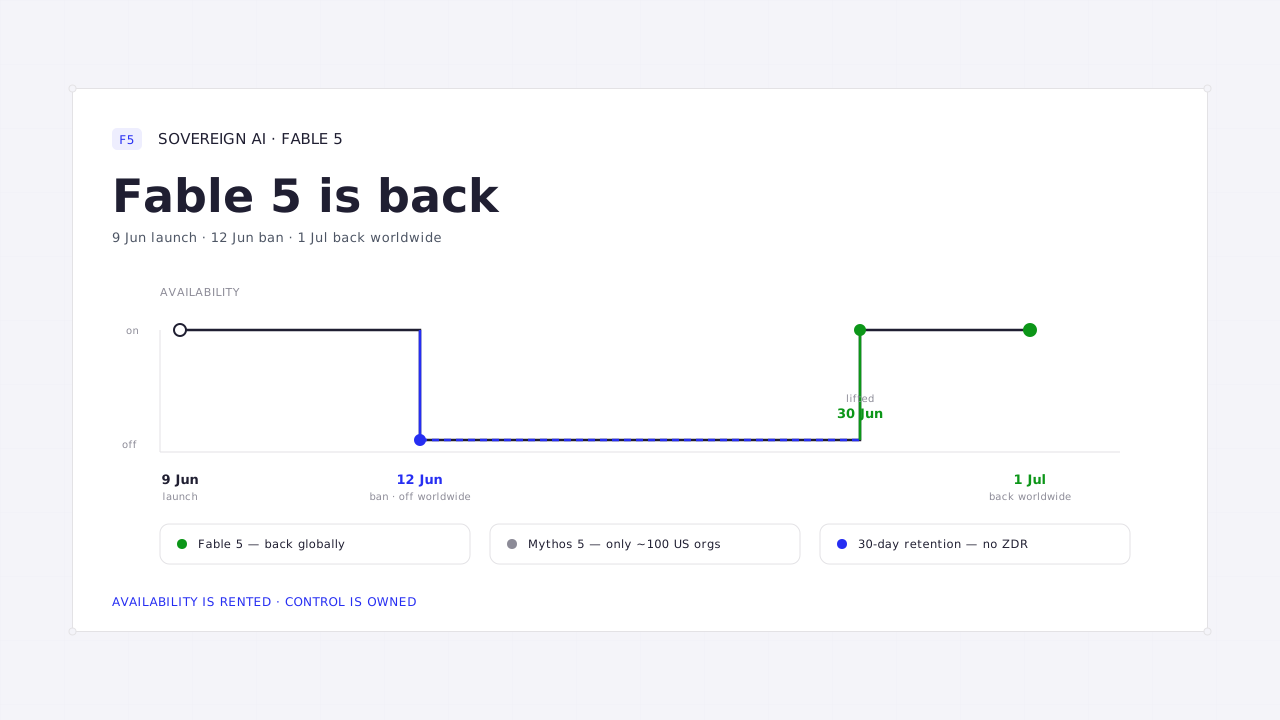
Fable 5 is back. On 1 July 2026, Anthropic re-enabled the model worldwide after the US Department of Commerce lifted the export controls. This does not refute the lesson of this article — it sharpens it. Read the full chronicle and what remains in the follow-up, Fable 5 is back — and why data sovereignty matters more than ever.
On 9 June 2026, Anthropic released Claude Fable 5, its most capable publicly available model to date: state-of-the-art results on nearly all tested benchmarks, a one-million-token context window, multimodal. One customer — the payments company Stripe — used it to migrate a 50-million-line Ruby codebase in a single day. Measured purely on capability, it was the strongest generally accessible AI building block yet.
And then it was gone.
About three days after launch, Anthropic pulled Fable 5 worldwide for all customers — to comply with a U.S. export-control directive that blocked access for foreign nationals. For a European company that had built its production environment on this model, the message was stark: the strongest tool in the world was available on Monday and unreachable by Thursday — and you, as a "foreign" user, were explicitly the blocked group.
This is more than a footnote. It is the clearest lesson yet on why, for data-sensitive and regulated companies, the deciding factor is not the biggest model but control over data, operations and knowledge. Let's look closer.
Fable 5 is here — and gone three days later
The facts are quickly told, and well sourced. Anthropic introduced Fable 5 as the first publicly available member of its new "Mythos" class — the most capable broadly deployed Claude model, with a one-million-token context window and up to 128,000 output tokens per request. Pricing: roughly $10 per million input and $50 per million output tokens, about double the recently released Opus 4.8 (see the Anthropic announcement).
Only about 72 hours later, multiple outlets reported that a short-notice U.S. export-control directive required Anthropic to remove access for all foreign nationals — triggered by reported security concerns around a jailbreak vulnerability. Anthropic suspended Fable 5 worldwide to comply (see, for example, the reporting).
To be clear: this is not a criticism of Anthropic, and Fable 5 is without question a remarkable model. What matters is the structural lesson — and it applies equally to every U.S. frontier provider.
Why the strongest frontier model alone is not a business outcome
A top benchmark score solves none of the real problems of a regulated company. A generic model is impressively well-read in general — but it knows nothing about your organization. Business value only appears when raw model capability becomes a defensible, verifiable answer to your question.
Three blind spots: missing knowledge, hallucinations, availability risk
Three gaps separate "strongest model" from "useful in operations":
- Missing organizational knowledge. Fable 5 doesn't know your contracts, project files, bills of quantities or internal standards. A model without access to your documents can say nothing binding about your specific tender.
- Hallucinations. Without grounding in real sources, a language model produces plausible-sounding but unsupported answers. In a liability or compliance context, that is unacceptable.
- Availability risk. Fable 5 demonstrated it: an API model can be switched off, repriced or regulated overnight — without your involvement and against your interest.
The CLOUD Act and the problem with the U.S. cloud
Then there is jurisdiction. U.S. providers are subject to the U.S. CLOUD Act — regardless of where their data centers sit. An "EU data center" on the product page does not protect you from a lawful U.S. access request if the providing company is subject to American law. The term sovereignty washing has emerged for exactly this: a marketing promise without substantive control.
The Fable 5 shutdown and the CLOUD Act are two sides of the same coin: in both cases a foreign jurisdiction decides on your access to — and access into — your own tools and data. A compounding point: Fable 5 can only be used with mandatory 30-day data retention; there is no zero-data-retention option. So the strongest model offers less data control, not more.
Sovereign AI: what the term really means in 2026
Sovereign AI means full control over three things: your data, the model in use and operations — under a jurisdiction that lies outside foreign access rights. Everything else is sovereignty on paper.
Concretely: data residency in your own company or data center, a data-processing relationship you control, swappable models instead of vendor lock-in, and operations that don't depend on a single external API. Digital sovereignty is therefore not an ideological question but a commercial one: it is the insurance against precisely the risks Fable 5 made visible.
Local, on-premise, air-gap: the tiers of data sovereignty
Data sovereignty is not a switch but a staircase. Which tier is appropriate depends on your compliance requirement — from DORA through NIS-2 to KRITIS.
| Tier | Data location | Jurisdiction risk | Typical use |
|---|---|---|---|
| Public cloud AI | Provider servers | High (e.g. CLOUD Act) | Non-critical, anonymous data |
| "EU cloud" of a U.S. provider | EU region, U.S. company | Medium–high (sovereignty washing) | Limited reliability |
| On-premise / local | Your own infrastructure | Low | Regulated industries, sensitive documents |
| Air-gap | Isolated, offline | Minimal | Highest confidentiality, critical infrastructure |
Lokalaise deliberately targets the lower two tiers: a fully locally operated stack, air-gap capable on request. More on our Security & data sovereignty page.
Grounding in your own knowledge beats the bigger model
This is where the real lever sits — and it is counterintuitive. The difference is made not by the bigger model, but by AI grounded in your own documents. Your competitors have access to the same models you do. What they don't have is your project knowledge, built over twenty years.
Tellingly, Anthropic itself reports that persistent, file-based memory improved Fable 5's performance considerably more than it did the less capable Opus 4.8 — by roughly a factor of three. Read the other way: the biggest gain came not from raw model intelligence but from grounding the model in a specific, persistent body of work. That is precisely the thesis behind grounding.
How retrieval-augmented generation (RAG) works — and why it's GDPR-friendly
With RAG, the model receives the relevant excerpts from your real documents before every answer and responds on that basis — with citations instead of free invention. The knowledge lives in a searchable knowledge layer (a vector database), not in the model core.
Three properties follow that are decisive for regulated industries:
- Fewer hallucinations. Answers are tied to real source passages and are therefore verifiable.
- Traceability. Every statement carries its source and an audit trail — essential for sign-off and liability.
- GDPR-compliant deletion. Because the knowledge sits in the database rather than the model, it can be removed selectively (right to be forgotten) without retraining a model.
Example AEC: from a thicket of standards to searchable project knowledge
In architecture, engineering and construction (AEC) this gets concrete. Bills of quantities, standards, project files, correspondence and minutes form a body of knowledge in which the decisive fact often exists — but nobody finds it in time. An AI grounded in exactly these documents answers questions like "Which change orders affect item 3.4 of the bill of quantities?" with a reference to the specific source. That is concrete, non-substitutable value — not a generic chatbot promise. More under Solutions.
Frontier performance AND sovereignty — a contradiction?
The obvious worry: choosing data sovereignty means giving up peak performance. In practice that is a fallacy. First, capable, locally deployable models are now more than sufficient for the bulk of business tasks. Second — and more important — a well-grounded mid-sized model usually beats a larger model with no access to your documents on the quality that matters to you. You don't have to choose between performance and control.
The managed local AI stack: hardware, models, operations and knowledge from one source
That is exactly what a managed local AI stack is for. Lokalaise combines four layers into a finished result: a connector layer that links your existing sources (file shares, SharePoint, DMS, email, scans) without a migration; a permission-aware knowledge layer that makes everything searchable and citable; an agent layer for recurring workflows; and managed operations on hardware located at your site. You're productive in about 14 days — with measurable value, not an AI project you have to run yourself. The full architecture is on our Platform page.
What decision-makers should do now
The Fable 5 week is a cheap opportunity to honestly review your AI strategy. Four questions get to the core quickly:
- Data sovereignty: Do your sensitive documents leave your company — and under which jurisdiction do they then sit?
- Availability: What happens to your operations if a central model is switched off, blocked or repriced tomorrow?
- Grounding: Is your AI anchored in your own knowledge — with citations and an audit trail?
- Exit risk: Can you swap models without rebuilding your entire knowledge base?
If any of these gives you pause, it's worth a conversation. In a short demo we'll show you what a sovereign AI stack, grounded in your knowledge, looks like in your company.
Frequently asked questions
Conclusion
Fable 5 is an impressive tool — and the clearest evidence yet for why you shouldn't build your business on a single, externally controlled model. Model capability is rented and volatile; knowledge grounded in your own documents is owned and compounding. Take data sovereignty, grounding and operations into your own hands, and you get frontier capability without being hostage to it.

Written by
Marius Gill
CTO @ Lokalaise