A dangerous misunderstanding is doing the rounds: that the Digital Omnibus "softened" the AI Act and bought everyone time. That holds for the high-risk obligations — but not for the transparency obligations. Those apply from 2 August 2026, and they bind not only providers but also deployers: every company that uses AI.
The deadline is only weeks away. This article cleanly separates what was deferred from what stays, clears up the often-confused distinction between provider and deployer, and gives you a checkable checklist. Up front, plainly: this is a professional briefing, not legal advice.
What the Digital Omnibus deferred — and what it didn't
On 7 May 2026, the Council and Parliament reached a provisional agreement on the Digital Omnibus, the first major amendment to the AI Act. It defers the high-risk obligations — but the transparency obligations under Article 50 stay on 2 August 2026. Equating "deferred" with "done" overlooks exactly the obligations that bite first.
| Obligation | Originally | Now | Status |
|---|---|---|---|
| Prohibited practices (Art. 5) | 2 Feb 2025 | 2 Feb 2025 | applies |
| AI literacy (Art. 4) | 2 Feb 2025 | 2 Feb 2025 | applies |
| GPAI obligations (Chapter V) | 2 Aug 2025 | 2 Aug 2025 | applies |
| Transparency (Art. 50) | 2 Aug 2026 | 2 Aug 2026 | applies — not deferred |
| High-risk, Annex III | 2 Aug 2026 | 2 Dec 2027 | deferred |
| High-risk, Annex I (embedded) | 2 Aug 2027 | 2 Aug 2028 | deferred |
Two caveats belong to honesty: the Omnibus began as a provisional political agreement (7 May 2026) — the European Parliament adopted the text on 16 June 2026, so only the Council's formal adoption and publication in the Official Journal remain (expected before 2 August 2026). And one detail does touch Article 50: the machine-readable marking of synthetic content by providers (Art. 50(2)) applies from 2 August 2026 in general; only generative AI systems already on the market before then get a four-month grace period to 2 December 2026. The other transparency obligations are unchanged.
Provider or deployer? The distinction decides
Under Article 3(4) of the AI Act, a deployer is any natural or legal person using an AI system professionally under its own authority. A provider is whoever develops it (or has it developed) and places it on the market under its own name. So most companies using a third-party AI tool are deployers — and carry their own obligations, independent of the provider.
Article 50 splits the duties along this line:
Important: anyone who substantially modifies, adapts or offers an AI system under their own name can additionally become a provider — and then carries both sets of duties.
The deployer duties under Article 50 — the checklist
For deployers, two paragraphs matter most — plus the rule on how disclosure must happen:
| If you, as a deployer, … | … then you must (Article 50) |
|---|---|
| use emotion recognition or biometric categorisation | inform the affected persons of its operation (50(3)) |
| generate or manipulate deepfakes (image, audio, video) | disclose that the content is AI-generated or -manipulated (50(4)) |
| publish AI text on matters of public interest | disclose the AI origin — exception: human review with editorial responsibility (50(4)) |
| make any of these disclosures | give it clearly and distinguishably, at the latest at first interaction or exposure (50(5)) |
The provider duties — flagging the AI interaction (50(1)) and machine-readable marking of synthetic content (50(2)) — apply on top if you provide systems yourself. To support labelling, the European Commission published a (voluntary) Code of Practice on marking AI-generated content on 10 June 2026. The Code is voluntary — the underlying Article 50 obligations are not.
What happens on a breach — and who checks?
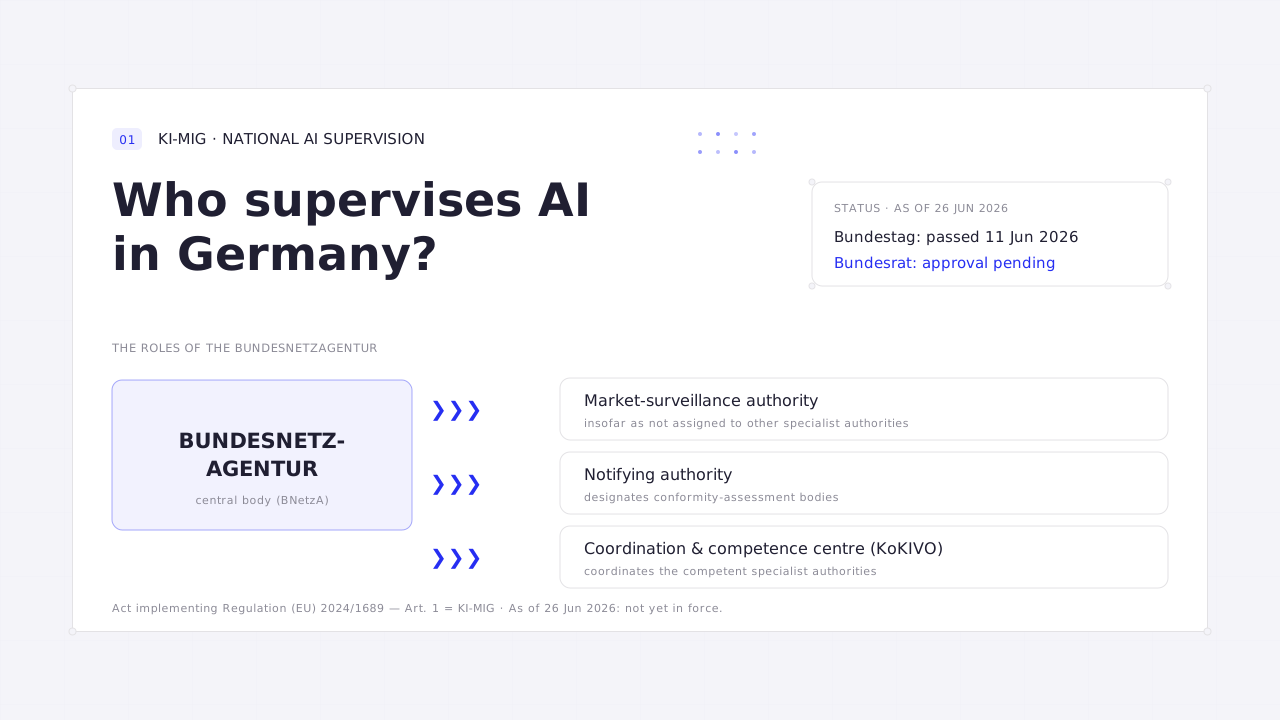
Breaches of the transparency obligations can be fined up to EUR 15 million or 3% of total worldwide annual turnover under Article 99 of the AI Act — whichever is higher. In Germany the Bundesnetzagentur becomes the central market-surveillance authority: the Bundestag passed the implementing law (KI-MIG) on 11 June 2026; the final step in the legislative process is still pending. The supervisor is getting its national teeth right on time for the deadline.
How a local, auditable stack makes compliance easier
Transparency, labelling and traceability are not architectural accidents — they are a property. An AI stack that delivers sourced answers (every statement backed by a source) and logs every retrieval in an audit trail makes disclosure and documentation duties practically achievable, rather than something to reconstruct after the fact. That is exactly how Lokalaise is built: a grounded, permission-aware knowledge layer on your own hardware, with no external APIs — with traceable data flows you can actually evidence to a supervisor (see Security & data sovereignty).
It fits the wider sovereignty thread we described using the cloud criteria: BSI C3A: when is a cloud truly sovereign? — and why uncontrolled AI use also gets expensive, we show in our piece on shadow AI. To be clear: Lokalaise is an enabler, not legal counsel. Which of your use cases fall under Article 50 is something to assess with your legal team — we provide the technical foundation.
Your next steps
Three questions create clarity fast — answer them for every AI use in your organization:
- Role: For this system, are you the deployer, the provider — or both?
- Trigger: Do you generate deepfakes or publish AI text on matters of public interest? Does the human-review exception apply?
- Evidence: Can you, if challenged, evidence disclosure, labelling and data flows?
Wherever you hesitate, it's worth a closer look. In a short demo we'll show how a local, auditable AI stack practically supports meeting the transparency obligations.
Frequently asked questions
Conclusion
The Digital Omnibus defers the high-risk obligations — the transparency duties under Article 50 stay on 2 August 2026. Anyone using AI is a "deployer" and must label deepfakes and AI-generated text on matters of public interest, clearly and at the first interaction. Disclosure, labelling and traceability are easier when answers are sourced and data flows are documented. That is no substitute for legal advice — but it makes the obligations achievable.

Written by
Marius Gill
CTO @ Lokalaise